
Delftse Slaolie, Jan Toorop & Art Nouveau in the Netherlands
27 October 2025
I drifted into the world of design history. I’m still learning about it and probably will be for a long time yet as part of my academic work, but of late I’ve been particularly interested in better understanding local design history. These blog posts are some distillation of that process, and they begin with what seemed to me a natural blend of interests: local history (Delft) and art nouveau, a style to which I have found myself repeatedly drawn for some years.
From what I can tell, if one discusses Art Nouveau in the Netherlands, it is customary at some point to bring up salad oil posters. By all accounts slaoliestijl (salad oil style) is an acceptable synonym here for Art Nouveau, and it’s all due to Jan Toorop’s marketing posters for the NOF (Nederlandse Oliefabriek = Dutch Oil Factory). I’d seen Toorop’s poster and a few others like it (see below) in my wanderings through books and museums, most recently in the Dedel Design Museum in Den Haag. Only recently did I discovered Toorop as the creator. In fact, my attention was brought to this through a casual read of an article in the Public Domain Review (a source of many fascinating tales from history). I generally do not like to focus investigations on individual people - part of an intentional move away from supporting the notion of the ‘Starchitecht’ or genius designer - but I think Toorop’s tale deserves to be a bit better known alongside his famous graphic art.
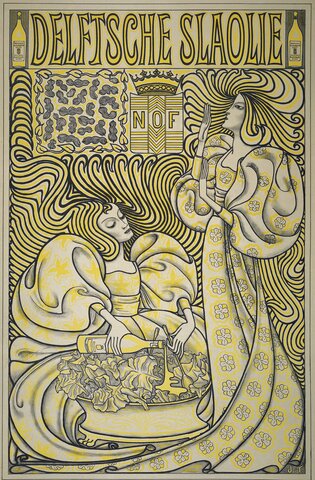
Jan Toorop’s 1894 Delftse Slaolie Poster (Source: Rijksmuseum)
To start, I only discovered later that his daughter, Charley, seems to be the better known and more highly regarded artist in the family. Jan was born in Java, which for me invokes a myriad of discussions about opportunities for people in that part of the world under Dutch control during the mid to late nineteenth century. Was it common (for the wealthy) to travel or study in Europe? What was the art scene, if it could be called a scene, like in Java during the late 19th century? How did life differ in Java vis-a-vis Amsterdam? I don’t really have answers to these questions, but they are in the back of my mind when looking at Toorop’s work and his stylistic influences. So far the majority of information I was able to find on Toorop and his posters comes from historians of art who naturally tend to focus on the art itself. Multiple sources, or perhaps several tracing back to one, suggest that the figures in his posters resemble Wayang shadow puppets. I can see this, but I could equally see these as somehow related to the pale colours and elongated figures in other European art of the time. I immediately think of Kirchner’s German Expressionist works or perhaps Matisse’s ‘La Danse’, though both of these appearled a little later than Toorop’s salad oil design. Part of the appeal in Toorop’s work - this poster and others - lies in its strangeness, that the figures were eerie and weird when he made them and they remain so today. Perhaps the inspiration for them matter less than their effects.
Toorop’s connection to Delft, one of the original prompts for looking into his poster, seems to have been relatively limited. For a while (1876-79) he studied drawing at my current university, then known as the Polytechnic School. I would like to know a little more precisely what he studied and with whom, but I’ll doubtless circle back to this in other musings on Art Nouveau & the university. It isn’t his school days but rather his later graphic artwork that binds him to the city. The slaolie poster was commissioned by the NOF, a company began in Delft by Jaques van Marken (who might merit his own space in the Design History of Delft) and operated in the city from 1883 until the factory ultimately closed in 2008. This according to Calvé (now better known as purveyors of peanut butter in NL), whose website states that Toorop’s poster was their first advertisement. It was also to be their most famous among the few that were produced.
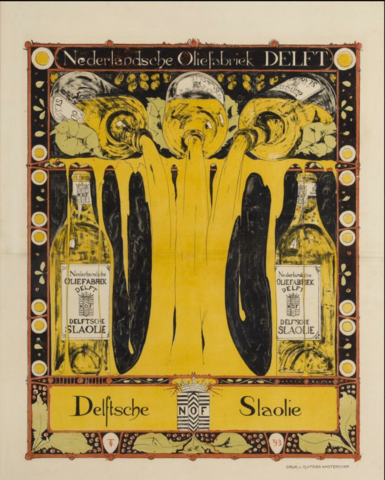
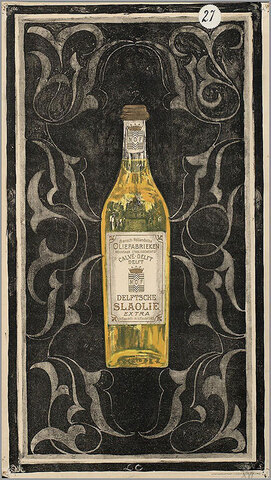
Later slaolie posters created by Theo Nieuwenhuis and Carel Lion Cachet.
Perhaps some final comments, for now, on the afterlife or alternative lives of the poster. We now view this primarily as a work of art, and in its own time the poster was part of an exhibition in Paris (Exposition d’Affiches artistique). Are there still venues for admiring the art & design of marketing items? I find it difficult to believe, but this perhaps due to a profound personal distaste for pushing wasteful consumerism. It’s somehow easier, probably due to the alienation of time, to appreciate the aesthetics of Toorop’s poster in the same way one does Mucha’s opera posters or, more prosaically, the ones he made for LU biscuits.
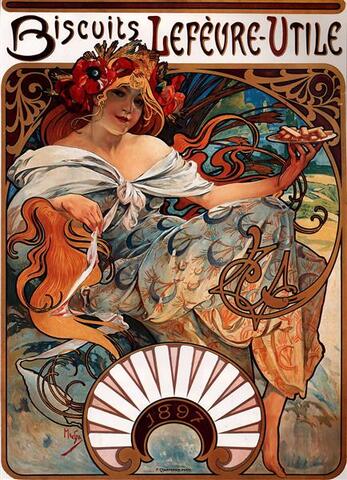
Mucha’s 1896 poster advertising LU biscuits
I wonder how the NOF commission contributed to Toorop’s livelihood. This wasn’t his only commercial venture - he also produced materials for a life insurance company in Arnhem as well as cover designs for a couple of Louis Couperus’ novels (have a look at this blog for a couple of nice examples). I haven’t read anything in Toorop’s own words, and I wonder what he thought about using his art for commercial purposes and how this work affected his career during his lifetime. I also wonder what he would have thought about it earning him some degree of fame more than a century later.
Refs & Further Reading
- Calvé history timeline: https://www.calve.nl/over-calve/timeline.html
- Eliens, Titus et al. 1996. Kunstnijverheid in Nederland 1880-1940.
- PDR short article on Jan Toorop: https://publicdomainreview.org/collection/the-salad-oil-style-of-jan-toorop/
- Short bio of Toorop from the Museum Boijmans van Beuningen: https://www.boijmans.nl/en/collection/artists/17666/jan-toorop
- Wayang puppet theatre (UNESCO Intangible Heritage): https://ich.unesco.org/en/RL/wayang-puppet-theatre-00063
- Wezel, Gerard van. 2016. Jan Toorop : zang der tijden.
- Wigersma, Friso. 1983. _100 jaar bekijks, 1883 - 1983 : een keuze uit de affiche-collectie van het Stedelijk Museum Amsterdam = 100 years on view, 1883 - 1983 : a selection from the poster-collection of the Stedelijk Museum Amsterdam
Images:
Toorop’s poster: https://id.rijksmuseum.nl/200399428 Other slaolie posters: https://iaddb.org/#/query/f07067ba-3256-4ddb-929c-757f0dcbb92c (Nieuwenhuis) ; https://www.cluysenaer.nl/vreelandse-superster-krijgt-aandacht/ (Cachet) Mucha’s LU biscuits: https://www.wikiart.org/en/alphonse-mucha/biscuits-lefevre-utile-1896 Toorop’s book covers: https://anno1900.nl/2018/11/03/de-couperus-banden-van-jan-toorop/
